Author Archives: brockshetley

Lesson 20

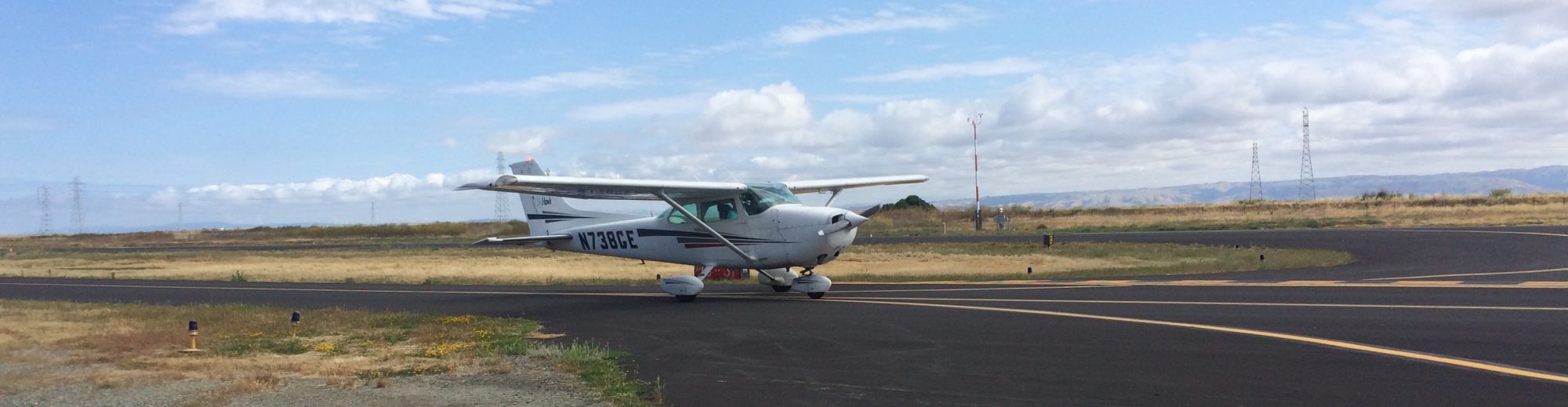
During the rollout of my fourth landing, my CFI asked me to let the tower know we needed to pull over to drop off an instructor for a student solo. Wow—it’s time. Was I nervous? A little. But was I extremely excited? Absolutely!

       so·lo
         noun
         a thing done by one person unaccompanied, in particular.

A thing (that being flying in this example) done by one person unaccompanied is precisely what happened. As my CFI jumped out on the Juliet row, he joked that I need to “bring [his] headset back” and to have a good time. I was ready! I monitored the ATIS and called ground ready for taxi. There was a slight delay—just enough to get my heart-rate up—at the end of the taxiway before I was cleared for takeoff. But I soon found myself releasing the brakes, running through my checklist (lights, camera, action) and taking the runway.

The goal was three (good) landings. In my opinion, my first was my best. I set-up the approach for a long, stable final and was completely configured over a mile out. My CFI had been encouraging this for a while and I really took it to heart to make sure I could “stick” these landings. 3, 2, 1—I heard the wheels touch down in the perfect order for a right-crosswind landing. My next two landings weren’t as graceful. And on the last, I bounced.

Today was great. I had been looking forward to soloing for quite a while and the actual process was as exciting as I had been hoping for. I’m not cleared to solo on my own yet. We are going to fly together again and perform another “supervised solo,” but after that I’ll begin to check the plane out and practice landings, maneuvers and general airman-ship on my own.

Watch the video below to sit in the cockpit with me during my first solo lap around the pattern.

Lessons 17 18 19

These three lessons were packed full of landing practice in preparation for solo flight. One of the challenges that has held me back from soloing is an inability to schedule consistent lessons and fly back-to-back days (or at minimum two times a week.) There seems to be a scheduling conflict each time I have steady progress. But upon the completion of Lesson 19 and several successful strong crosswind landings, I think there is a high likelihood Lesson 20 may include me flying solo.

During Lesson 17, we took a little bit of time to practice emergency descents (watch the video here.) Demonstrating two different types of emergency descents was helpful. The first, full flaps and a 45º bank, we managed to lose about 1,500 ft/min—not bad. More impressive, however, was the second descent. Forcing the plane into a full slip, we achieved a descent rate of over 2,000 ft/min. Both of these tools will be helpful if I ever need to go from a high altitude to the ground in a controlled manner (i.e. in the event of a cabin fire.)

Lesson 18 and 19 were spent at PAO working on aligning the nose during crosswind landings and we also practiced several non-standard landings—power off approach and no-flap approaches. The power off approach proved to be a real challenge with a 10-15 kt crosswind. Biggest takeaway: make sure you’ve made the field before making big adjustments such as “dumping the flaps.” If you don’t have enough energy left to make the runway, you’re not going to be able to add more power in the event of a real engine failure.

While wrapping up Lesson 19, I told my CFI I could meet first thing the following morning. He affirmed he could too and I began to secretly hope that this would be my solo flight opportunity. Lesson 19 had some great landing practice and I was confident the winds would be light enough in the morning for me to take to the pattern on my own… We’ll see!

Lesson 16

It felt good to be back in the plane today. During my time away (a little less than two weeks), I became very anxious about my training. Mostly due to the last lesson I had and my poor performance, but also just about the speed at which this training is occurring and the cost associated. My plan from the beginning was to minimize cost by flying no less then twice a week, and hopefully fly three times a week when able. More flying = more retention = quicker training program = less cost. It’s a fairly easy formula to follow.

Nevertheless, I’m committed to earning my PPL during this period in my life and that desire was reinforced today during a pretty decent pattern session on Runway 13. My first time landing/departing 13 was a trick. Wow—it took a good amount of effort just to fly a rectangular pattern; something I haven’t had trouble with since the easy lessons. The wind was very calm for my first few landings (thankfully) and I brought the plane down gently. A few of the landings were relatively flat, and a few I could have aligned the nose better, but for my first time back at it, I was happy and so was my instructor.

The last landing today made me smile. A crosswind had presented itself by the end of the lesson, and if you’ve been reading along, you’ll know from my previous posts that I don’t do well with crosswind. But everything came together quite well. I stabilized the approach and used the right amount of aileron and rudder to keep the plane aligned all the way to touchdown. 1, 2, 3. I could distinctly hear each wheel touch the pavement—exactly how it should sound when landing with a crosswind. 🙂

We called it a day after that landing. I’m happy to be back in the plane and excited to keep trucking toward my solo flight.

brockshetley

July 24, 2016

I need to take a small break from flying to attend to some family business in Oklahoma. I’ll be back soon ~

Lesson 15

“Terrible.” One word easily describes how I feel about my lesson today.

I’m not sure if it was the crosswind, my schedule circumstances or a combination of the two, but the wind was blowing wildly from the side and I took a break during the middle of an unplanned overtime shift to make this lesson happen. To begin, I was flustered from being called in on my day off to work. There was no way I was going to miss this lesson, however, so I negotiated for an hour off in the middle of my shift to fly. I believe this feeling of being rushed contributed greatly to my performance during the lesson. For some reason I could not get my approaches stabilized or perfect my landings. I came in crooked or high each time and ended up executing GO AROUNDS several times.

My instructor could tell I was getting frustrated, and he did his best to try and reassure me that the problems I was experiencing weren’t just occurring to me, and that most students struggle with crosswind. That helped, slightly. But I still felt like I should be doing better than I was for the number of hours I have trained thus far (20.2).

Lesson 14

Less than 24 hours passed between disembarking the XL Airways France A330 that brought me home from Europe, and beginning the preflight checklist for N733ZK. Since it had been a little while since I last flew, my instructor wanted to stray from pattern work today and opt for coordinated turn practice, a stall refresher and VOR tracking.

We departed on a left Dumbarton and quickly configured the airplane for slow flight. She performed as sluggish as I remember. This configuration transitions us into power-off stalls. I executed these /almost/ within ACS margins—still plenty of time to practice. Something we tried  today that I had only attempted once (and was very bad at) was steep turns. I quickly felt comfortable making these maneuvers and pleased myself when I felt the “wake” from where I had begun the turn.

The VOR tracking was nothing too exciting. You dial in the frequency for whichever VOR you want to track. Identify it. And then verify if you’re tracking toward or away. The neatest part of this exercise was actually flying over the top of Woodside VOR and 1) seeing the needle swing around INSTANTLY when I crossed over, and 2) seeing the VOR with my own eyes. I use the Woodside VOR on a daily basis as a visual reference for pilots when I’m controlling air traffic.

Lesson 13

  • One item on the agenda for today: Not perform as bad as I did in my last lesson. In all seriousness, I plan to learn from yesterday’s mistakes to improve my landings today.

I scheduled an afternoon lesson today to accommodate a change in my CFI’s schedule and to avoid 0900 Bay Area traffic—it’s the worst. Around 1330 we met at the aircraft. I had performed the majority of the pre-flight and was just about ready when my CFI arrived. We wrapped up the last few items on the checklist and called for a taxi clearance. We intended was to fly the pattern at PAO, but as we approached the run-up area, it was quickly apparent that the pattern was busy and we would be subject to ground and airborne delays. After one lap in the pattern, I requested a departure to HWD, anticipating there would not be a whole lot of traffic in the pattern. “Cessna 3ZK, right crosswind your discretion. Frequency change approved. Good day.”

Our anticipation was correct—HWD only had a few inbound and outbound aircraft. Now I could really begin to focus on my landings and pattern work. The headwind was pretty strong and as a result I came in very slow (almost too slow) a time or two. It was a little unsettling to see the airspeed drop to 53kts on a 1 mile final still at 500 feet. My instructor promptly corrected me and reminded me that the only correction in this case is to add more power and nose over the aircraft.

As far as the landings are concerned, the major thing I need to work on is aligning the nose. I definitely began to improve my rudder inputs by the end of the lesson, but the first several landings were not well aligned. As I came down from the ground effect onto the runway, the nose would swing and I would not react quickly enough to keep from bouncing sideways in the touchdown.

I am very happy with the flow I’ve developed for a pre-landing checklist. It rolls off the tongue naturally now that I’ve said it for six or seven lessons, and to prevent expectation bias, every few times I’ll glance down at my checklist just to ensure I didn’t miss an item requiring inspection.

On the return to PAO, I called inbound over Coyote Hills but experienced difficulty receiving a reply from the tower. After three attempts to call on Comm 1, I switched to the second radio and was immediately contacted by the tower asking “how do you hear now?” Loud and clear. I’m not sure what caused the communication failure, as that very radio had worked just fine moments before at HWD. I was secretly hoping for a chance to fly inbound squawking 7600—maybe next time 😉

Lesson 12

An easy way to describe my lesson today: “I was having an off day.” My flares were terrible. Each touchdown seemed rougher than any before. And my CFI kept reminding me of the exact same things on each turn around the pattern. For some reason I could not improve from touch-and-go to touch-and-go like I have been able to in the past.

I was presented with a slight crosswind out of the northeast for the majority of the lesson. While I have flown in wind stronger than this, my ability to provide the right amount of control to compensate for the wind was not there. I would overcorrect or not correct enough during the last 100 feet bringing us down for many flat landings and even a bounce or two.

Tomorrow we’re going to try it again. Hopefully I can compartmentalize today’s lesson and not let it affect how I feel arriving at the airport in the morning. I do have some takeaways from my lesson today:

  1. When there is a crosswind and a touch-and-go is performed, reorient the controls back into the wind once on the go. My instructor needed to remind me of this every single time today.
  2. Make small corrections on approach and wait out the result. If I find myself left or right of centerline, apply a small amount of aileron in the needed direction and let the plane gradually work its way over.
  3. On takeoff roll, reduce the control into the wind as rotation speed grows closer. At the point of rotation, there shouldn’t be zero control into the wind, but it should be much less than at the start of takeoff roll.

Happy last day of June ~