Category Archives: Flying

Lesson 11

The plan for today’s lesson was a flight to Half Moon Bay (KHAF) for pattern work and to do a refresher on stalls over the west ridge. My CFI and I met at the airport around 0900, I performed the pre-flight (which included mounting a GoPro this time) and then we called for taxi. This morning was a typical, busy Saturday morning at PAO. Taxiing to 31 via the terminal side, we were slotted as number four to enter the run-up, which meant we were number seven for departure. 15 minutes on the ground and we were finally able to pull-up and hold short—next to go!

We flew a Left Dumbarton departure, getting several different aircraft “in sight” that the tower controller was kind enough to call out for us (thanks Erik.) Tracking toward the Crystal Springs Reservoir, my CFI briefed me on the procedures for flying into and out of an uncontrolled airport and the proper way to identify yourself on the Common Traffic Advisory Frequency (CTAF.) We picked up the weather (33008KT) over the radio, then made our first call: “Half Moon Bay Traffic, Skyhawk 733ZK crossing the ridge now inbound for right traffic, Half Moon Bay.” The direction we were flying set us up best for a straight-in for right base entry to runway 30, but this is not the safest or best practice for entering an uncontrolled airport environment. My CFI told me to keep an altitude at least 500 feet above the pattern and fly directly for midfield. Overhead the airport, I made another call indicating that I was now flying outbound to enter on the right-45 for runway 30.

Each approach was strikingly similar to landing at PAO. The right traffic turns are always a little more of a challenge as the runway is on the far said of the aircraft from me, but each time I seemed to have plenty of time to stabilize my approach and bring it in for a decent landing. Check out the video below to follow-along through from the base turn all the way to exiting at taxiway bravo.

After pattern work, we departed via an overhead left-270 back for PAO. For the stall refresher, we made a clearing turn over SLAC and started with slow-flight and power-off stalls. I did a pretty decent job keeping within the standard margins and wasn’t nearly as started by the recovery as I was the first time we practiced. Power-on stalls, however, still made me a little uneasy. We called PAO from the south when we were about finished practicing. I figured we would have a delay coming back into the pattern as the tower controller was working their booty off to keep up with the volume. Sure enough: “Cessna 733ZK, Palo Alto Tower, hold over the dish, I’ll call you back.” Thanks Eric—I really appreciate your help 🙂

We used the holding time wisely and did a quick refresher on turns around a point. About 10 minutes later, we were called to make left-traffic toward runway 31. Upon entering the pattern, I was told my number in line. I was seventh to land and began anticipating to at least extend as far as Hangar One at NUQ before turning base. I was correct. And even was asked to make a right-270 back to base to build some space for a departure. Busy morning for departure… Busy afternoon for landing. Saturday at PAO!

Today was great. Thanks to the departure and arrival delays, I totaled up another 2.0 hours in the logbook. Planning to fly at least two more times before my Europe trip with all hopes of perfecting my landings and being ready to solo not long after returning to the States.

brockshetley

June 23, 2016

Is there a better way to spend a “Saturday” night than studying for the private pilot written exam? Probably so. But I find myself cracking open the digital book known as the Internet and putting in some work for this test. My goal is to pass the written prior to leaving for Europe. That’s less than two weeks away, so godspeed to me. Big thanks to Ivan for the study materials—thanks buddy!

Lesson 10

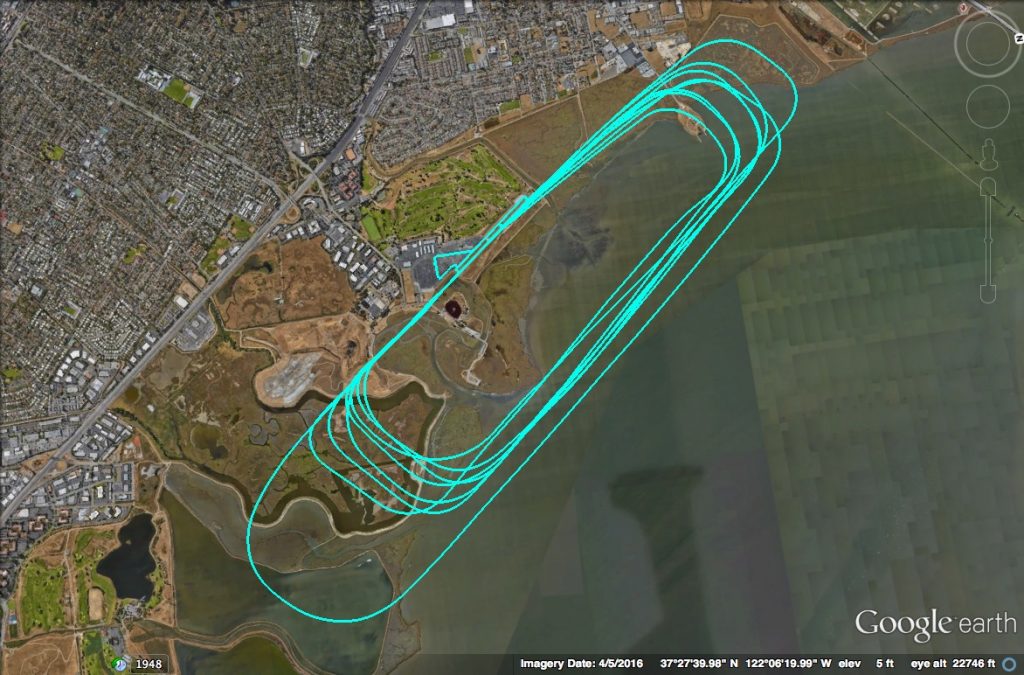
A log of GPS coordinates can tell you a lot about an individual’s life or tell a story about a circumstance. Be it an overprotective parent putting a tracker on a just-turned-16-year-old’s car. Or law enforcement targeting potential criminals (with proper warrants, of course.) Once you connect the dots between the coordinates, a picture is complete that speaks as loud as words. For pilots, GPS data quickly and distinguishably relays exactly how and where the aircraft flew, what turns were made, and often even the altitude at which the plane was flying. Below is my work of art from today’s lesson. We stayed in the patten at PAO, and looking at the tracks I created on each pass around the airport brings me back to the left seat and allows me to replay each lap in my mind.

GPS track of N738GE in the pattern at PAO.

GPS track of N738GE in the pattern at PAO.

Notice the track above that extends almost to the bottom of the image. During that lap, I was instructed to extend downwind, creating space for departures. I learned today that when you expect to fly a longer downwind and ultimately a long final approach, it is normal to delay power reduction and keep the flaps to a minimum. I can also reflect on my tracks above and see how my 10° offset on departure (for noise abatement) could use some work.

While I was under the impression that I had “landed” the aircraft during my fourth or fifth lesson, today I learned what it truly felt like to land without input—either mechanical or verbal—from my CFI. During our fifth crosswind to downwind turn, my CFI told me he was going to say as little as possible on this approach and was confident I could bring the aircraft to the ground without his instant feedback. Challenge accepted! I completed my pre-landing checklist; began configuring for the approach; made my base turn; added more flaps; stabilized the approach; descended into ground effect; made a decent flare; and then very gently banged the mains onto the ground. “Very nice,” my CFI said. And I agree—it did feel nice. Not the smoothness of the landing itself, but the shear feat of delivering the aircraft to the ground on (what felt like) my own.

My takeaway from today is the absolute necessity of applying right rudder when pitching to a nose high attitude during the flare. I could not have been more aligned with the centerline during each approach today, but as I would apply that last, hefty amount of back pressure during each flare, my nose would swing away from the centerline. As the aircraft pitches up, P-factor returns and must be compensated for.

Lesson Nine

Yay! Back in the left seat for the first time in nine days. It was refreshing showing up and performing the pre-flight. I like the systematic approach taken toward the entire feat of flying. There are checklists and redundancies in place that reinforce the safety culture surrounding aviation. I was asked today by a co-worker: “What is the number one fatal mistake made by pilots?” Why I’m sure there are statistics that back up a better answer than what I told my buddy, I replied to him that becoming comfortable—skipping a checklist or neglecting to do a pre-flight—seems like a very unnecessary risk to take that I would imagine contributes heavily to fatal accidents.

Our lesson today consisted of departing PAO for Livermore Airport (LVK.) The weather was perfect for VFR flying today—not a cloud in the sky this morning. Entering the pattern at LVK, I was on alert for traffic to follow as I had not been addressed by the tower since my initial call about 8 miles out. Finally the local controller calls out my traffic to follow and I immediately get them in sight. The Cessna was turning downwind just off our nose. While I was a little startled by this proximity (because we would never let two get that close together without so much as a traffic call at PAO), it did not quite compare to the following scenario…

About 60 seconds later, the local controller issued a right-360 to a Cirrus (SR22) in the left-downwind—a control instruction that caught my attention. Here was my thought process:

  • We were in the left-downwind…
  • The Cirrus was in the left-downwind…
  • But I didn’t have the Cirrus in sight…
  • …LOOKING for traffic

I immediately looked out the right window and BOOM, there was a SR22 peeling away from us in what I would describe as a 45º bank. A few moments later I clarified with the controller that we were following the correct aircraft, which she confirmed. The Cirrus pilot then began to question her about the “Skyhawk that peeled right in front of [them].” All ended well, but it was a rather startling sight to look out the window and see an aircraft’s belly as they turn away from you. This scenario definitely gives meaning to the phrase “see and avoid.”

↓ Listen to the ATC audio below. I’m N738GE if you can’t tell from the voice. ↓

Audio courtesy of www.liveatc.net

Save the entry to the pattern at LVK, the rest of the lesson was enjoyable and informative. My landings still have a way to go before solo flight, but I’m improving my control inputs and lightening my grip on the yoke. On the way back to PAO, we simulated an engine failure at 3,500 feet over the San Antonio reservoir. You can see in the map below the tight turns over the water feature. I picked a landing spot directly below us when my CFI cut the power, established best glide, then completed the checklists for “engine failure.” We had more than enough altitude to make the field I chose, so I decided on a right-270 back to “base” to bleed off more altitude.

Check out the map below. It shows my track from PAO to LVK, a quick circle around the reservoir, than back to PAO for a few more landings.

brockshetley

June 17, 2016

It’s been over a week since I’ve flow. I was supposed to fly on Monday, but had OT assigned to me that interfered with my lesson, thus causing me to cancel. Then I was supposed to fly on Thursday, but a maintenance issue with the plane I had reserved grounded us. Now, over a week since my last lesson, I am supposed to fly in the morning—fingers crossed.

Lesson Eight

After today’s lesson, I feel confident in saying I’m “starting to get the hang of it.” We practiced more pattern work today, providing me another opportunity to improve on and perfect the things I’ve been struggling with in my previous lessons. While still nowhere near perfect, my landings were more controlled and my CFI commented that he only had to apply a small amount of correction on a couple of the touchdowns. For the most part, all the landings during todays lesson, no matter how rough, were my doing.

I flew in N733ZK again today. There is an appreciation developing for how much easier taxiing is in this Skyhawk and for the overall better control I have over the rudder while in flight. My CFI has also noticed that this aircraft seems to perform better (while it’s only a very marginal improvement) than N738GE. For $5 more an hour, it might be worth it to book this plane more often and avoid the headache of lousy rudder pedals.

Logbook Update

The first page of my logbook is filled. In just a little more than three weeks, I’ve totaled up nearly 10 hours toward my private pilot’s license.

Airplane SEL 9.7 hours
Dual Received 9.7 hours
Day 9.7 hours
Total Flight 9.7 hours
Landings 38

Lesson Seven

For the seventh lesson, we practiced more pattern work. Number one goal for today’s lesson: don’t nose over when landing.

This goal is a carryover from errors in my previous lesson. And the extra thought an attention I put into not pushing the nose down payed off—my CFI was pleased and my landings began to improve. I have also been contentiously trying to relax my grip on the controls ever since I was threatened with having to hold an egg between my palm and the yoke. It seems to be working and I feel that the aircraft provides much better feedback when I am looser on the controls and not white-knuckling during landing.

A mistake I continually made during our several landings today was applying back pressure too swiftly while still flying in ground effect. As a result, I ballooned…every time. Just like I had to be intentional about not nosing the aircraft over during the flare, I am going to need to be intentional about making very minute changes to the controls when in the final stage of landing.