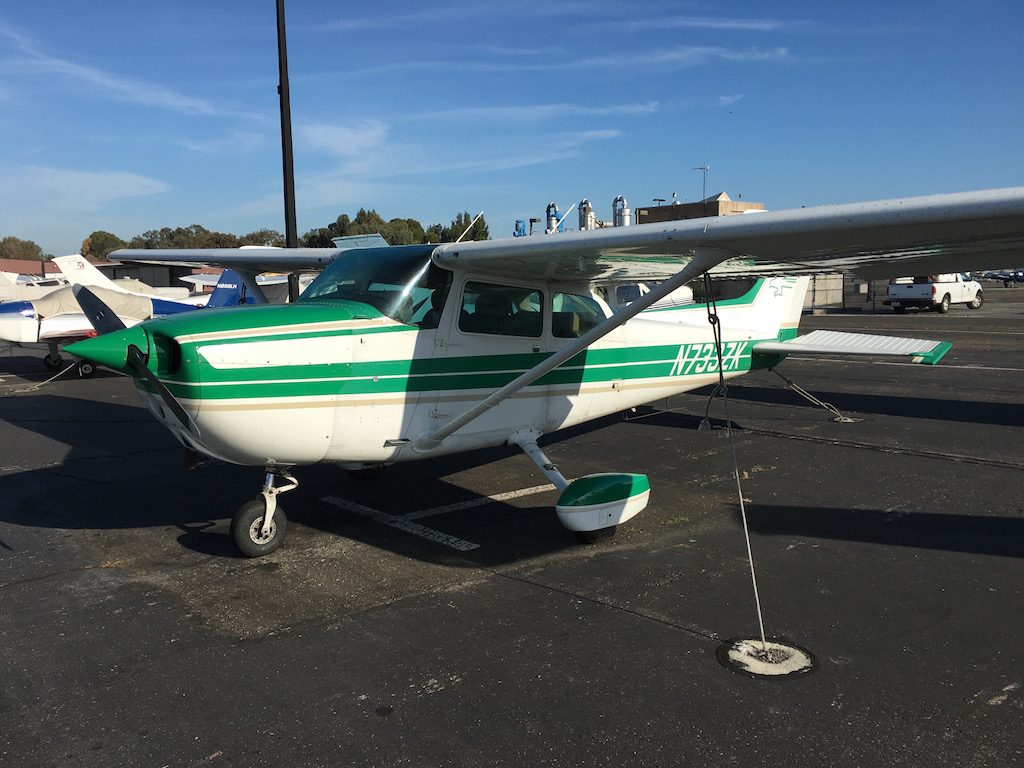
Today consisted of strictly pattern work in a new (to me) Skyhawk. The 172 that I rented for the first five lessons was booked solid today, so I ventured toward another one of the 172 “N” models. This aircraft, N733ZK, is not the most attractive aircraft in the fleet, but my instructor was optimistic about flying in it do to his impression that it handles better than the 172 we had been flying in.
There is not a lot to say about pattern work. It’s similar to driving a race car around a track, but instead of driving across the starting line each time you come around, you have to manipulate a flying machine that is pivoting on three axes safely back onto the ground—or you GO AROUND.
My biggest hang up with our lesson today (and subsequently each of my approaches) was a tendency to nose over during the landing flare and push the aircraft down onto the runway. By the end of the lesson, I was catching myself before making this incorrect gesture. But it absolutely required a good deal of self control to NOT to push the yoke over and ride out the ground effect or any ballooning.
For my fifth lesson, my CFI wanted to fly to a few of the local airports to practice more landings and familiarize me with local airport procedures. Today was my first lesson in the evening; a nice change from the cloudy, cool mornings. We completed the normal pre-flight procedures then departed the pattern for San Carlos (KSQL).
Only a little more than six miles to the northwest, SQL is a quick hop in a Skyhawk when departing runway 31 at PAO. I didn’t immediately switch to the SQL ATIS frequency after PAO Tower approved my frequency change, and before I knew it, it was time to call SQL Tower for a pattern entry. My CFI told me to just advise I was “negative ATIS,” which was slightly difficult for me to say over the radio. My biggest pet peeve when I work Local control is having an aircraft intentionally tell me they don’t have the ATIS. But in the case of flying from PAO to SQL, there is very little time to pick it up, so allow me to make an excuse for myself…thank you! I think this real-life lesson will encourage me to exercise more patience with pilots when they advise they’re “negative ATIS.”
The SQL Tower controller advised me on initial contact that the winds were out of the west—a left crosswind. A friend of mine advised me, “if there’s any left crosswind component, you’ll feel it as turbulence in the last 100 or so feet before touch down because the hangars and the business park next to the airport affect the airflow…” So I was definitely preparing for that unsteady air as I established myself on the approach. Sure enough, I felt the wacky wind and my CFI even commented on it after our third lap around the pattern.
After a few more turns in the pattern, I requested a Belmont Slough departure toward Hayward (HWD). Without delay, I picked up the HWD ATIS when my approval to change frequency was received from SQL—I would not be checking in “negative ATIS” for a second time today. Banging the pattern at HWD was a breeze. Though I am not very good at landing yet, the width and length of runway 28L is a dream for a beginner pilot. I will definitely look forward to flying here once I am comfortable manipulating the controls of the aircraft.
Sunset was approaching, so we made our way back to PAO. Calling inbound over Coyote Hills (with the ATIS), I already had my traffic to follow in-sight. One interesting aspect of learning to fly at the airport I control at is the “behind-the-scenes” knowledge I have of how we operate the airspace. This knowledge allows me to anticipate what the controller is going to ask of me. I realize I need to be careful with this and not allow an expectation bias to creep into the cockpit. But for now, I’m appreciating the ease I find in maneuvering into and out of the PAO delta, and my CFI has even commented that he is enjoying training me knowing he does not have to worry about the radio communications or local procedures at Palo Alto.
Today’s lesson consisted of pattern work followed by a Left Dumbarton departure to practice more maneuvers over the west side of the valley. I am learning very quickly that being taught to fly is a true challenge—both of the mind and body. This entire experience has the potential to be very rewarding and I look forward the sense of accomplishment I will experience upon completion of training.
There was a lesser crosswind component today than present in my last lesson. This lack of crosswind allowed me to focus more on my subtle movements with the yoke and kept me overall less tense on the controls. My CFI has consistently needed to remind me that I cannot truly appreciate the feedback the plane is providing to me if I am too tight on the controls. He has considered placing something gross feeling on the back side of the controls or having me hold an egg between my palm and the yoke to prevent me from gripping too hard. I told him I would make a conscious effort to relax and avoid the need to hold an egg—I then realized he was joking.
The maneuvers we practiced included steep turns and power-on stalls. Unlike power-off stalls, a power-on stall is completed in cruise or takeoff configuration. There is a tremendous amount of back pressure required to stall a Cessna in this phase of flight. But as long as you hold it and keep increasing that angle of attack, the aircraft will stall. This maneuver felt less extreme than the power-off stall and the recovery happens almost instantaneously.
Today’s flight was my longest yet. Two hours on the hobbs for a grand total of 5.6 hours of instruction!
Today was a typical, windy day in the Bay Area. While most days and especially afternoons are this way, I’ve gained a new respect for this constant phenomena. Being at the mercy of the wind while in flight is a humbling notion.
There was a crosswind component from the west (28015KT) today that enticed my instructor into teaching me about crabbing into the wind on departure and slipping on approach. I became very impressed rather quickly with the agility of the aircraft when inducing a slip on final. I also learned about placing the controls into the wind on takeoff roll and reducing the amount of aileron as your approach Vr. We did several laps in the pattern then departed on a Right Dumbarton for the salt flats.
With the strong west wind, my instructor wanted to practice ground reference maneuvers—this time I would have to take the wind into account for my turns. My instructor demonstrated turning around a fixed point, revealing to me that less bank is required when facing into the wind, and much more aggressive input is needed when turning with the wind. If you’re not on top of your turn, the point you are turning around will be completely off-center in no time.
The weather today was a great improvement over the conditions during my first lesson. A 4,000 foot scattered layer of clouds presented a good opportunity to practice slow flight and power-off stalls to the east. Also, something I didn’t mention in my first post was the slight nausea I experienced while practicing turns right below an overcast layer. (And by right below, I absolutely mean at least 500 ft below.) I was looking forward to the cloud deck being much higher for our practice today to hopefully alleviate any nauseousness.
Before departure, I went through the motions of the pre-flight inspection with my CFI similar to the first lesson. He advised me that he would soon prefer to just meet me at the aircraft, bestowing on me the responsibility of showing up early and pre-flighting the aircraft on my own. I liked this idea for two reasons. One, it seems that I will develop a better appreciation for the pre-flight when I am the one determining the aircraft’s airworthiness. And two, if I have the pre-flight complete when my CFI shows up, that saves me minutes on the clock toward the instructor fee.
Time to taxi—which means time to improve on my horrendous taxi job from the first lesson. I requested a Right Dumbarton departure with the ground controller and began making my way toward the run-up. My movements on the ground were a slight improvement over the first lesson. The muscle memory of how much pressure needs to be applied to the rudder pedals kicked in quick. We performed a quick run-up in accordance with the before take-off checklist and then proceeded to depart to the north east in the direction of Livermore.
Over the San Antonio reservoir, we climbed to 3,500 ft and configured the aircraft for slow flight. I soon learned how unresponsive and sluggish the controls become when you have a relatively low airspeed. After a few turns at slow speed, we commenced the power-off stalls. Wow! The human body is definitely not naturally comfortable when the aircraft you’re flying in suddenly begins to drop out from under you. Luckily the feeling does not last for long. The Skyhawk is an inherently stable aircraft, meaning it will correct itself during a stall as long as you don’t apply too much input to the controls and try to over correct—let it fly.
I met with my CFI for the first time at Sundance Flying Club. We spent about an hour in the club going over the plane checkout process, talking about fundamentals of flight and developing a plan for our first flight. The weather was not immediately cooperative for this first lesson. The ceiling was around 800 ft, but was forecast to begin burning off by 9:30.
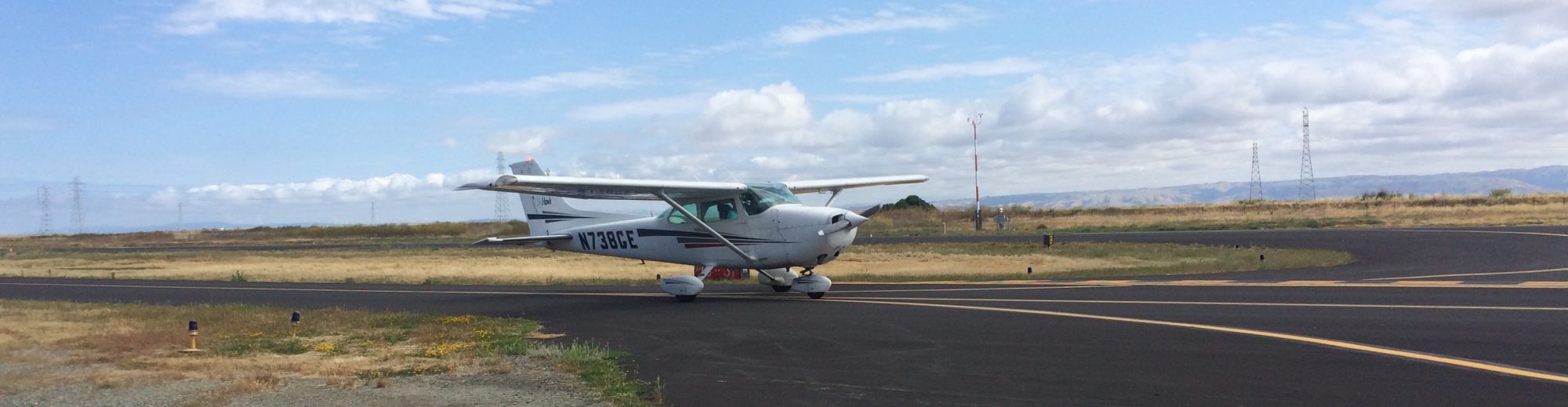
We made our way to the ramp and I followed my CFI around the aircraft for a pre-flight inspection. My original plan for flight instruction included learning in a Cessna 152, but an accident at the airfield just over a week ago totaled the only operating 152 in the Sundance fleet. As a result, I will be learning in a Cessna 172 and my first flight took place in the aircraft pictured in the header at the top of this blog.
At the conclusion of the pre-flight, I noticed the rotating beacon had been deactivated indicating the field had cleared up to Visual Meteorological Conditions (VMC) which would allow us to fly under Visual Flight Rules (VFR.) My instructor had decided we would depart the delta to the north and practice maneuvers of the Leslie Salt flats. I called Palo Alto Ground for a taxi clearance and began taxiing toward the runway.
My first attempt at taxiing was not stellar. The pedals required an incredible amount of pressure that I didn’t anticipate needing to apply. My instructor helped me pull into the run-up area and we began the before takeoff checklist. We then covered the basics of what to check during the run-up and I was briefed on the function of each instrument on the panel. Time for takeoff!
I feel like this first lesson was definitely trial-by-fire. My instructor left it up to me to taxi onto the runway, align us with the center-line and commence the takeoff roll. The result of his persistence I do these things on my own can be seen in the video below… I let the first fourth of the runway creep by while barely increasing airspeed, completely unaware that “full throttle” means all at once in one smooth motion. My instructor kept saying “full throttle, full throttle,” but it wasn’t registering that I could apply it all at once. Finally he told me to either apply full throttle NOW or we would need to abort the takeoff. I got it then!
We practiced the following maneuvers, then headed back in for a total of an hour on the hobbs.
Rectangular pattern
Parallel flight
Lesson one was definitely a success. My number one takeaway is the amount of work required to taxi. It looks very simple as I watch planes taxi past the tower each day. But I now understand and appreciate the amount of effort being put in to the activity.
Early rise today to catch a 6:13 train to London Paddigton from Bath. Arrived around 7:45 after an easy train ride.
Very full day in London seeing all the sights. The first on the list was Greenwich Royal Observatory—which I had never been to before because I didn’t realize how central it was to London. It was so cool. Like the Omniplex for adults is how I would describe it! Next was London Bridge and a walk down the Thames to see Shakespeare’s Globe Theatre, the London Eye, and across Westminster Bridge for some excellent views of Big Ben and Parliament. A final stop in the park for a quick rest, then it was on to dinner at Wagamama.
Tonight we had tickets to see Wicked in the Apollo Victoria Theatre thanks to an awesome birthday present! What a fantastic show performed beautifully by the cast as if it were being shown on Broadway, minus the Kristin Chenoweth part of course. 🙂
Did a little packing this evening and it’s up tomorrow bright and early to head for Heathrow. It’s been a great trip, saw some really neat things, wore myself thin a few times and had an absolute blast through every part of it!